This page is dedicated to information about Guglielmo Marconi
Following shortly after Heinrich Hertz's physics lab demonstrations, Marconi developed what is generally recognized as the first practical "generator" of radio waves in Italy in 1895. (There are several conflicting claims of primacy, including one for a Russian named Aleksander Stepanovich Popov in the same year.) Because the Italian goverment declined to back his efforts, Marconi moved to England.
During the 1895 to 1901 period, Marconi worked on improving his new "wireless telegraph," attempting to sell it to the British Navy. Also attempting to sell his development to the British Post Office, Marconi demonstrated transmission over several miles in 1897.
Marconi transmitted the results of the International Ocean Yacht Races off Sandy Hook, NJ to the New York Herald Tribune in October, 1899. He finally received British patent 12,039 on July 2, 1897. Patent 7,777 (issued in 1901) covered a selective tuning device to resonate the antenna circuit of a spark transmitter.
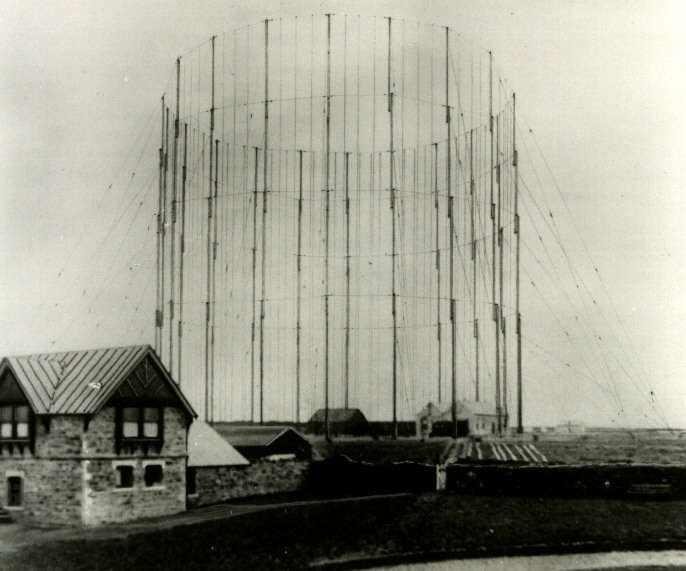
The first transatlantic transmissions were attempted from a four tower circular array at Poldhu, England. The wooden towers were each 200 feet (61 meters). Transmission was approximately 500 meters or 600 kHz with an input power to a spark transmitter of around 18 kilowatts. Originally, 20 towers were built into the array, however, they towers were toppled by storms in November 1901, and the four replacement towers were hastily.built for the transatlantic transmission.
Reception of the letter "S," three dots, was reported by Marconi on December 12, 1901, at Signal Hill, St. Johns, Newfoundland. The transmitter was manned by John Ambrose Fleming, professor of University College in London, later to invent the diode vaccuum tube. Interestingly, it may be that Marconi probably did NOT hear the actual "longwave" tranmission but may have heard a shortwave harmonic. Discussion of reception and picture of commemorative plaque.
In 1909 Marconi shared the Nobel Prize awarded for the field of Physics.
The Poldhu Antennae;
Here's a photo of the original 20-tower antenna at Poldhu. The true history seems to be this was built in anticipation of transatlantic work (as was a similar array at Wellfleet on Cape Cod), but storms in November, 1901 blew the masts down, causing Poldhu to rush to complete 4 wooden towers, while Marconi used a kite-supported receiving antenna up in Newfoundland.
We may finally have discovered a definitive answer to the matter of 4 versus 20 towers at Marconi's first transmitter plant in Poldhu. Here's the URL of a portion of the Cable & Wireless history site in England, showing a 4 tower arrangement as being Marconi's 1901 antenna at Poldhu. That is very much in line that Marconi had indeed originally intended to build 20 towers, but was deterred by a combination of storm damage and cash limitations following it.
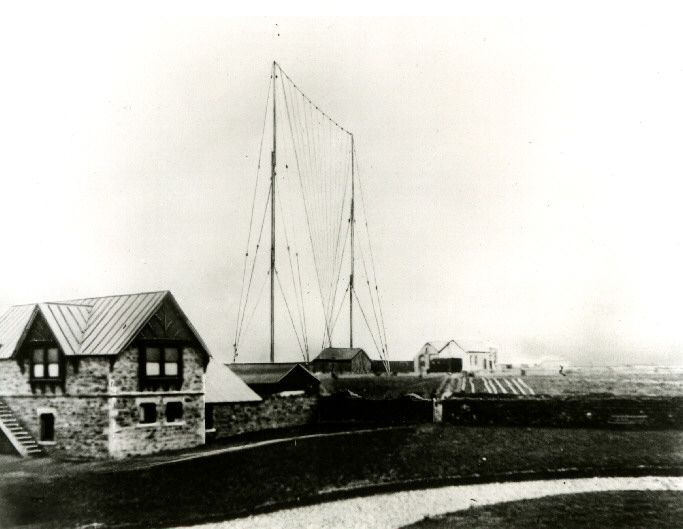
Here's a picture of "Poldhu's SECOND antenna, 1901." It's obviously what Marconi rebuilt after losing the 20-tower array, and note it has only TWO towers!
The pictures of the 20-tower and 2-tower arrays were found on an Italian language site dedicated to Marconi.If you speak Italian, check it out.
Newfoundland turned out to be temporary as the cable companies got Marconi the bum's rush out of town when he proved successful. Shortly thereafter, the Canadian government (Newfoundland was an independent state at the time) offered Marconi space at Glace Bay, Nova Scotia, which he accepted. Glace Bay became the regular Marconi transatlantic telegraph service operation, while Wellfleet became Marconi's ship service station. Wellfleet's original callsign was CC (for Cape Cod), becoming MCC for Marconi Cape Cod, and ultimately WCC when callsigns were issued by the FCC. WCC, of course, was well known for decades as a part of the RCA that flowed out of US nationalization of Marconi's assets during WWI.
Parts of the narrative have been provided by Don Kimberlin.